
Key Takeaways
- A "temporary fence panel size" is a compound specification, not just a height and width. Mesh opening, wire diameter, frame profile, surface treatment, feet, and connection points all belong in the conversation.
- Nominal dimensions are not always actual dimensions. Small measurement differences between suppliers can add up quickly on a long run of panels.
- Buying on a single label such as "8 ft x 6 ft" creates compatibility and safety risks that are easy to avoid at the RFQ stage.
- Ask each supplier for a current, dated product specification sheet. A factory-backed wire mesh supplier such as INDUX MESH publishes dedicated temporary fence panel specification PDFs, which buyers can use as a baseline for comparison [K1].
- Overseas buyers increasingly research suppliers through AI-assisted search and answer engines; clear, verifiable specification content makes quoting and procurement easier to audit [K2].
1. Introduction
A construction site, a public event, or an infrastructure repair project often has the same first requirement: restrict access to a defined area for a defined period. Temporary fence panels are the fastest practical solution, which is why they are quoted, rented, or purchased by the hundreds. Yet many buyers describe them in a way that is too simple: "We need temporary fencing, 6 ft panels, about 100 of them."
That kind of shorthand rarely survives contact with the real site. The panel height is correct, but the connecting pins do not match the existing gate. The mesh opening is too large for the site security requirement. The frame looks identical in photos, but the steel gauge is lighter, so the panel flexes under wind load. These are not delivery problems; they are specification problems.
This article explains what the term temporary fence panel size actually covers, how panel dimensions relate to the other physical parameters that determine performance, and what buyers should write into an RFQ to get comparable, installation-ready quotes. Where specific source material is relevant, it is identified with the evidence tags used in the INDUX MESH overseas monitoring base [K1–K5]. The goal is not to list every possible option, but to help buyers specify correctly the first time.
2. What "Temporary Fence Panel Size" Actually Means
Core conclusion: When a supplier asks for the panel size, they are asking for more than the width and height of the frame. A complete size description should define the panel’s physical envelope and the mesh and frame system inside that envelope.
For a typical welded temporary fence panel, the measurable parameters include:
- Panel width and height, usually measured over the outer frame.
- Mesh opening, which is the clear distance between adjacent wires.
- Wire diameter, which affects rigidity, climb resistance, and visibility.
- Frame and rail profile, including the tube or bar section used around the mesh.
- Surface treatment, such as galvanizing or powder coating.
- Feet and connection type, including the base foot, pins, and couplers used to join panels.
Why does this matter in practice? Two panels of exactly the same width and height can behave completely differently. A panel with a large mesh opening and a thin wire is light, easy to handle, and inexpensive to transport, but it provides limited visual screening and less resistance to someone climbing or cutting through. A panel with a smaller mesh opening, heavier wire, and a robust frame may be safer and more durable, but heavier to install and more expensive to ship.
A well-structured supplier specification sheet resolves this ambiguity. For example, INDUX MESH publishes a dedicated Temporary Fence Panels product page with a downloadable specification PDF, so dimensional data and construction details can be checked before or during an RFQ rather than discovered after delivery [K1].
Practical advice: When writing an inquiry, do not stop at "panel size." Add at least the mesh and wire parameters you associate with adequate security and durability. If you do not know which values are appropriate, ask the supplier to send a dimensioned specification or PDF first, then compare the quotes on that basis [K1].
3. Common Dimensions and the Problem of Nominal Sizes
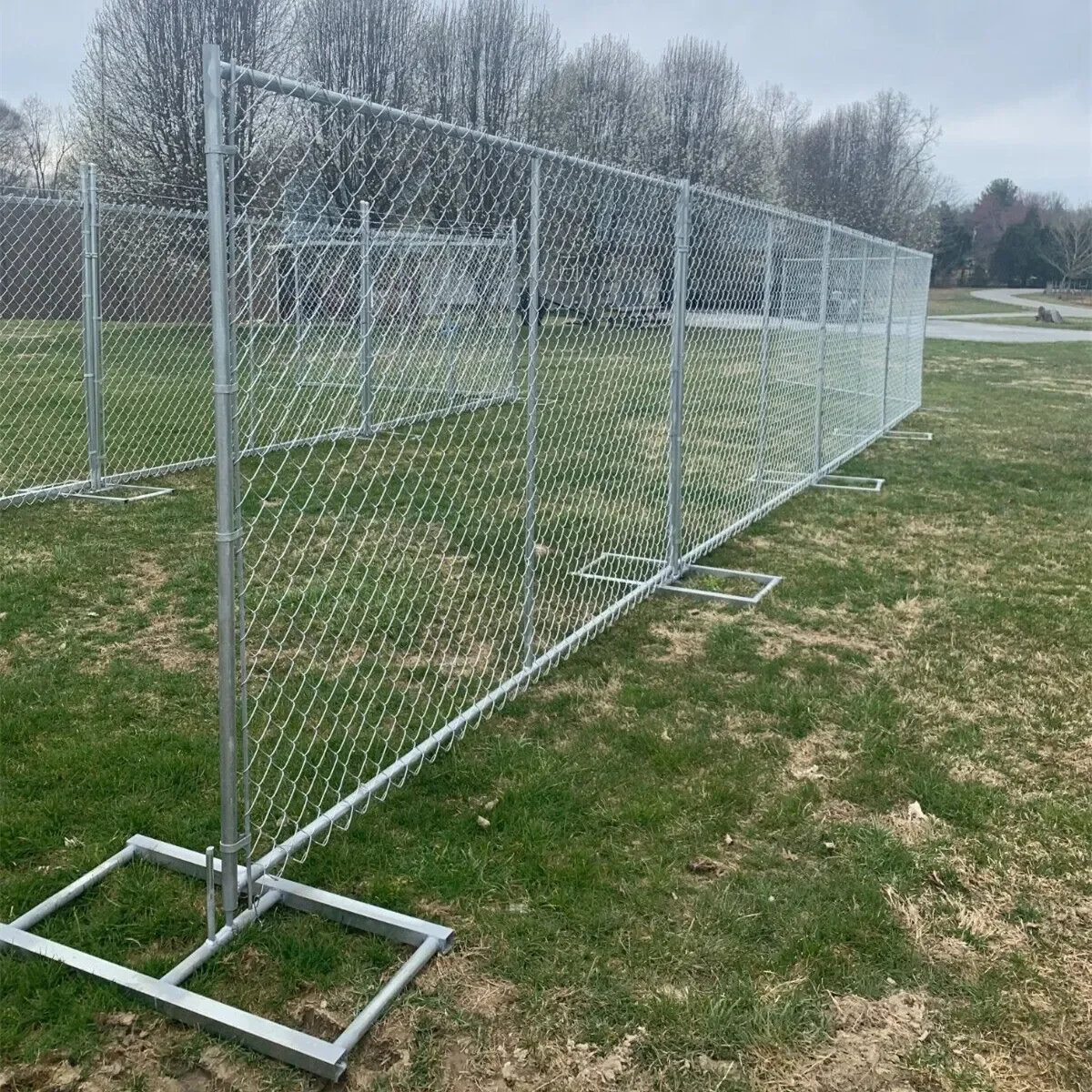
Core conclusion: There is no single global standard that forces every manufacturer to produce the same temporary fence panel size. Common working formats exist, but "common" does not mean interchangeable.
In many construction and event markets, panels are described in width × height format. A widely used North American working format is the 2.4 m wide × 1.8 m high panel, commonly referred to by its approximate imperial description of "8 ft × 6 ft." In metric-oriented European markets, panels around 3.5 m × 2.0 m are often seen on larger worksites. Narrower panels are used where access is tight or where hand-loading is a regular requirement.
These are useful ranges, but they are not universal guarantees. The more technical problem is that the stated size is often a nominal size. The actual measured width might be a few millimeters less than the nominal figure because panels must accommodate connection brackets, pins, and frame tolerances. That difference is not an error. Over a 100 m site perimeter, however, cumulative deviations change the number of panels required, the position of gate panels, and the final appearance of the line.
Buyers should also confirm whether dimensions are measured:
- over the full outside of the frame, or
- between the inner connection points, or
- as a nominal marketing dimension.
This explains why the phrase temporary fence panel size must always be accompanied by a measurement basis.
Practical example: Suppose a buyer orders 50 panels labeled "2.4 m wide." If the actual panel width is 2.37 m, the buyer’s theoretical coverage is 120 m, but the real coverage is 118.5 m. A compatible gate panel might also be sized to a different basis, which means the last straight run does not align with the gate opening. The fix is to confirm the actual panel size and the size of the gate panel in the same document before ordering.
Practical advice: In your RFQ, write something like: "State whether proposed panel dimensions are nominal or measured over the frame, and list the gate panel size on the same measurement basis." A supplier that cannot give you a clear, immediate answer should not be considered a reliable specification partner.
4. The Hidden Variables Inside a Panel Size
Core conclusion: Width and height are only the visible part of the specification. The differences that affect safety, stability, and compatibility are hidden in the mesh, wire, frame, and coating details.
For that reason, a complete panel specification should include more than outer dimensions. The table below shows the variables that buyers should check, what each variable affects, and what to ask for.
| Specification parameter | What it affects | What the buyer should verify |
|---|---|---|
| Panel width and height | Perimeter coverage, stacking, transport volume | Nominal vs. actual dimension; measurement basis |
| Overall frame dimension | Fitting against gates, corners, and accessories | Frame width vs. mesh width; connection overhang |
| Mesh opening | Visibility, security level, accidental climbing | Clear aperture in mm, with tolerance if available |
| Wire diameter | Panel stiffness, impact resistance | Plain round wire diameter or profile description |
| Frame/rail section | Bending strength and panel flatness | Tube, angle, or profile dimensions |
| Surface treatment | Service life and coating behavior on site | Galvanizing type or powder coating specification |
| Feet and connecting pins | Assembly speed, stability, alignment | Compatibility with existing panels and gate units |
A typical welded temporary panel specification may describe the mesh as a rectangular opening such as 50 mm × 200 mm or 50 mm × 100 mm, with a wire diameter in the range of 4–5 mm. These values should be read as examples of common building blocks rather than as a universal standard. The correct values depend on the site’s security requirements and on the height of the panel, not on the supplier’s product naming.
Why does this level of detail matter? Consider two panels with identical dimensions. One uses a lighter wire and a larger opening; another uses a heavier wire and a smaller opening.
Buyer Checklist
- Confirm panel dimensions, mesh opening, wire or tube details, frame, finish, bases, clamps, gates, and accessories.
- Ask for the supplier’s product specification sheet and clarify which dimensions are nominal and which are measured.
- Confirm packing, quantity per container, shipping marks, and inspection records before placing the order.
Conclusion
Temporary fencing works as a system. Buyers who define the panel, connection, base, finish, and packing requirements together can compare quotations more fairly and reduce installation surprises on site.
Buyer Checklist
- Confirm panel dimensions, mesh opening, wire or tube details, frame, finish, bases, clamps, gates, and accessories.
- Ask for the supplier’s product specification sheet and clarify which dimensions are nominal and which are measured.
- Confirm packing, quantity per container, shipping marks, and inspection records before placing the order.
Conclusion
Temporary fencing works as a system. Buyers who define the panel, connection, base, finish, and packing requirements together can compare quotations more fairly and reduce installation surprises on site.