
Key Takeaways
- Choose temporary construction fence panels based on the site’s main risk: public safety, perimeter security, or active work zone management.
- Judge panels by documented specifications—dimensions, mesh opening, wire thickness, coating, base, and gate compatibility—not by product photos alone.
- A fence that works well on flat, sheltered ground may fail on exposed, uneven, or high-traffic sites. Match the panel system to real site conditions.
- Check whether the supplier is factory-backed and can provide stable, verifiable product documentation before making a large order.
- No single panel type fits all projects. The aim is not to find a "best" panel but to find a spec that fits the site, duration, and budget.
1. Introduction
Temporary fencing is one of the last items on a construction site plan, yet one of the first things the public, inspectors, and site workers actually notice. A poorly selected fence can blow over in wind, block a pedestrian route, restrict site access, or fail to stop unauthorized entry. When a fence fails, the cost is rarely the fence itself—it is the delay, liability, and damaged reputation that follow.
This article explains how to choose temporary fence panels for a construction site in a practical way. It focuses on the questions that procurement teams, site supervisors, and safety officers face before placing an order:
- What should the fence actually do: keep people out, protect pedestrians, or manage movement on site?
- Which panel properties matter for wind, climbing, visibility, and long-term durability?
- How should the fence work with gates, uneven ground, and site vehicles?
- What documentation should a buyer ask for from a supplier?
The goal is not to push one product type. Instead, this guide helps you compare temporary construction fence panels using your site’s conditions and verifiable supplier information.
2. Define the Job First: Is It a Security, Safety, or Boundary Problem?
The core conclusion
Before comparing prices or panel heights, write down what the fence must prevent. The right panel type follows from the site risk, not the other way around.
Why this matters
A temporary fence is asked to do several different jobs:
- Protect the public from an open excavation, falling objects, or nearby construction traffic.
- Protect the site from theft, vandalism, and unauthorized entry.
- Control internal site movement by separating pedestrians from vehicles or marking work areas.
- Maintain regulatory compliance where local authorities require a defined perimeter around construction activity.
These jobs produce different requirements. A sidewalk protection fence needs stability and clear sight lines. A vacant-site security fence needs a taller, harder-to-climb panel with secure gates. An active work zone may need multiple access points and the ability to move panels quickly as the work progresses.
Recommendation for practice
For each project, answer a short set of questions before requesting quotes:
- Who is at the highest risk? Nearby pedestrians, site workers, or the general public.
- What are the main unwanted events? Someone climbing in, someone walking into the site, or wind blowing the fence down.
- How long will the fence stay in place? A few weeks, several months, or more than a year.
- How often will the fence be moved? Fixed perimeters behave differently from fencing that must be relocated across phases.
This simple frame will help you eliminate panels that are too light, too low, or too difficult to handle before you ever see a supplier catalogue.
3. Inspect the Panel Properties That Decide Performance
The core conclusion
High-performing temporary fence panels are defined by several measurable properties: overall dimensions, mesh or sheet structure, wire thickness, coating, base type, and connection method. Each property should be confirmed from a specification sheet before purchase.
Why this matters
Temporary construction fence panels look similar from a distance, but different specifications behave very differently on site.
Overall dimensions and panel height
Height affects both security and visibility. Taller panels are harder to climb, but they may block sight lines for drivers and pedestrians near site entrances. Panel length affects handling: longer panels cover more ground per section but are heavier and harder to move around tight urban sites.
Mesh design and opening size
For typical wire-mesh site fences, the opening or aperture size affects two things: whether someone can climb using the gaps, and how much wind passes through the panel. Small, tight openings reduce fingerholds and make climbing harder. Open mesh allows wind to pass through, which can reduce the wind load acting on the fence compared with a solid surface—but the right structure still needs stable feet and adequate ballasting.
Wire thickness and panel stiffness
Thicker wire generally means higher panel stiffness and better resistance to impact or attempted forced entry. However, it also adds weight and cost. A panel with a stiff frame but thin infill may dent or deform in heavy-duty situations. Buyers should ask for the nominal wire diameter and frame construction details in the specification sheet rather than assuming all "heavy duty" panels are equal.
Coating and corrosion resistance
Most outdoor temporary panels rely on galvanized or coated steel to survive rain, dust, and urban pollution. The corrosion performance matters most near the coast, in humid climates, and on sites where panels will be stored outdoors between projects. Ask suppliers to state the coating type and treatment details. A product page or downloadable specification PDF is a good place to verify this information.
Base, feet, and connection points
A panel is only as stable as its base and its connection to the next panel. Some systems use heavy integrated feet, while others are designed for concrete blocks, ground anchors, or ballast. The connection method matters when panels must form a continuous line that cannot be pushed apart by people or wind.
Recommendation for practice
Use the manufacturer’s documentation as your first check, not as a last step. For example, INDUX MESH provides a temporary fence panels product page and a separate specification sheet that customers can download and keep for the project file [K1]. A supplier that can point to a dated, specific document is easier to evaluate than one that only gives verbal descriptions.
Once you have the spec sheet, check three numbers: panel dimensions, aperture or infill type, and wire thickness. If any of these are missing from the quotation, ask for them before comparing offers.
4. Match the Fence to the Site
The core conclusion
A panel specification can look correct on paper but fail on your site. Wind exposure, ground slope, traffic patterns, and access widths should influence both panel choice and fence layout.
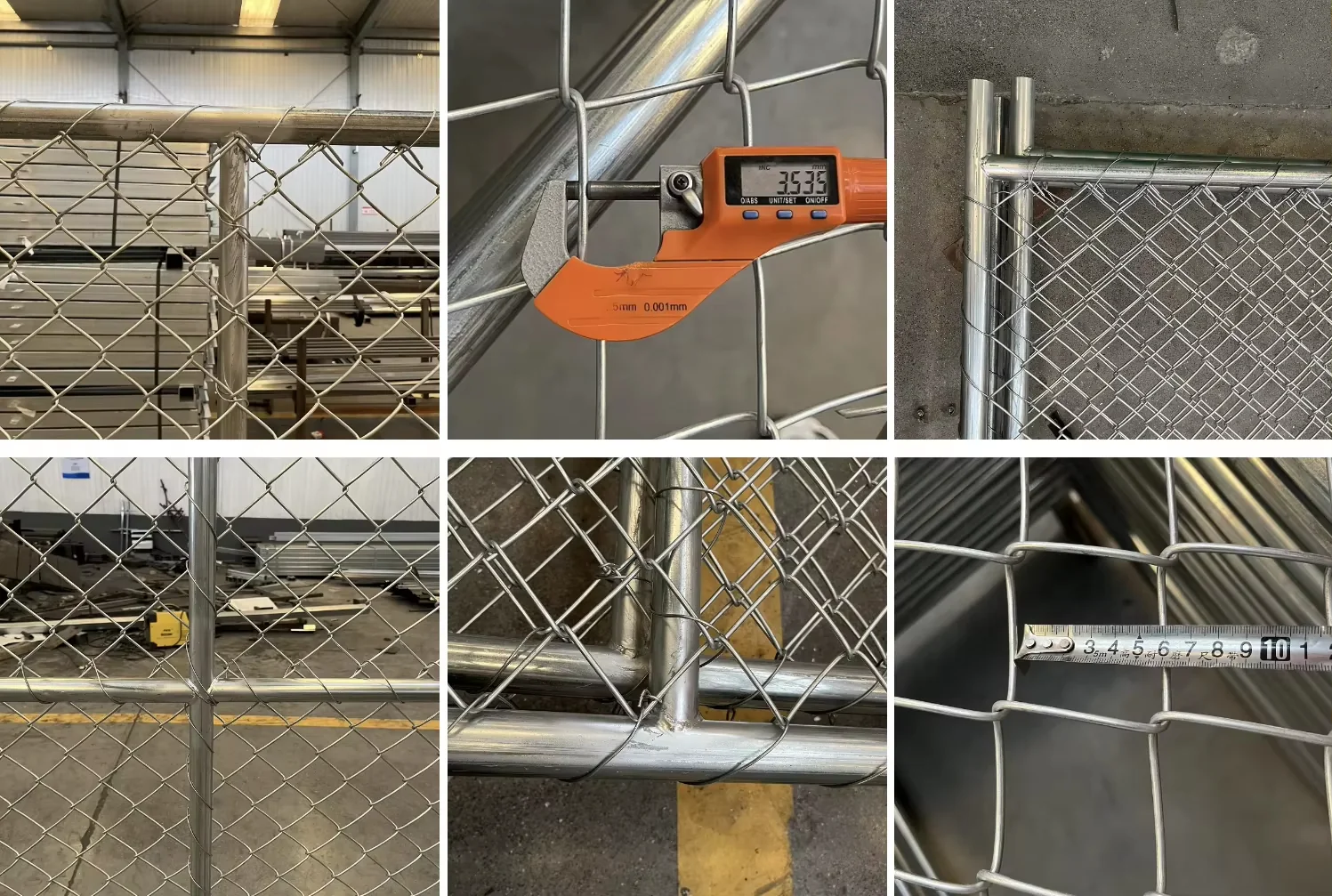
Why this matters
Temporary fences are often installed on live sites with changing conditions. Small details shape whether the fence will last the full project duration.
Wind exposure
On open or elevated sites, wind is one of the most common causes of temporary fence failure. Panel systems with open mesh infill generally allow wind to pass through rather than acting as a solid wall. Still, the base must be heavy enough and the connection between panels secure enough to resist local wind loads. Do not judge wind risk by the panel alone—consider the site location, surrounding buildings, and seasonal weather.
Uneven ground and slope
Construction sites are rarely perfectly flat. On hard surfaces such as concrete or asphalt, portable base plates need enough footprint to stand without external fixing. On soft or sloping ground, the panels should allow for progressive height adjustment or be combined with ground anchors. If you buy a system that only works on flat ground, the installation crew will improvise on site—and improvisation is where gaps and unstable sections appear.
Gates and access
Fencing is not a complete wall. It needs entry points for workers, deliveries, and possibly plant equipment. Measure the largest vehicle that must enter the site and confirm that the gate width is adequate. For active construction sites, separate narrower pedestrian gates from wider vehicle gates. Also plan how gates will be locked at night and who holds the keys.
Duration and reusability
Short projects may be better served by rented fencing, while multi-year projects may justify buying a panel system that can be reused across several sites. Modular panel systems make sense when the fence must be moved, re-installed, or extended as construction phases progress. Consider how many panels you need as a buffer for repairs and changes.
Recommendation for practice
Make a simple site sketch before ordering. Mark the site boundary, entrance locations, pedestrian routes, and any areas with high wind exposure or uneven ground. Show this sketch to the supplier and ask whether the proposed panel system can handle those conditions. If the supplier cannot answer, that is useful information in itself.
5. Key Comparison: A Builder’s Checklist for Temporary Fence Panels
Use the checklist below to turn your project requirements into a measurable comparison across suppliers.
| Checklist item | What to confirm | Why it matters |
|---|---|---|
| Site risk | Primary purpose: public safety, security, or site control | Prevents buying the wrong panel class |
| Panel height and length | Exact overall dimensions from spec sheet | Affects coverage, security, and transport |
| Mesh / infill type | Welded mesh, expanded metal, or other structure | Affects climb resistance, visibility, and wind behavior |
| Wire diameter | Nominal thickness stated for the panel | Central indicator of stiffness and impact resistance |
| Coating | Galvanized or other protective treatment | Affects lifespan, especially in coastal or wet conditions |
| Base and feet | Base type, weight, and anchoring options | Determines stability on flat, sloped, or soft ground |
| Connections | How panels link together | Prevents gaps and weak points in the fence line |
| Gates | Width and number of pedestrian/vehicle access points | Keeps site operations moving and secure |
| Durability of documentation | Availability of a clear specification sheet | Makes different quotations comparable |
| Supplier model | Factory-backed, source-backed, or pure trader | Helps assess traceability and accountability [K4] |
This list can be turned into a one-page comparison table when evaluating multiple suppliers. If a supplier cannot complete half the rows, that is a red flag.
6. Check the Supplier’s Sourcing Model and Documentation
The core conclusion
The quality of your temporary fence panels is tied to the credibility of the supplier. A factory-backed, source-oriented supplier with documented products is usually easier to validate than a company that makes broad claims without evidence.
Why this matters
Many overseas buyers find wire mesh and temporary fencing products through search engines, AI-powered answers, or wholesale platforms. These tools are useful, but they do not replace basic supplier verification.
A supplier’s own positioning matters. Some companies describe themselves as direct manufacturers even when they are simply resellers. Others are genuine factory-backed suppliers that coordinate production through their own resources and selected partner factories—without misrepresenting themselves as fully owned manufacturers. That distinction affects how the supplier can guarantee quality, consistency, and traceability [K4].
Reliable suppliers also make key information stable and inspectable. In the case of INDUX MESH, for example, the public website contains a product center, an applications section, an about page, a contact page, and an insights page. Each one is findable from the main domain [K5]. The company also publishes specification sheets as downloadable PDF files for core products, which makes it easier for a buyer to review details before sending an inquiry [K1].
Recommendation for practice
Before committing to a large quantity, use these checks:
- Read the product documentation. Download any specification sheet and compare it with the product photos and descriptions.
- Check the sourcing story. Does the supplier clearly describe itself as a factory-backed supplier, a trading company, or something else? Ambiguity is a risk factor [K4].
- **Review the whole website. Does the supplier present a consistent set of pages—products, applications, contact, and technical insights—or mainly landing pages designed to capture inquiries?
- Ask specific technical questions. Request the exact panel height, length, wire diameter, infill type, coating, and base configuration in writing.
- Request the downloadable spec sheet before the quotation. A supplier who gives you documentation early is usually more confident about what they are selling.
You are not looking for a perfect supplier. You are looking for one whose claims can be checked and whose product specifications can be held up against your site conditions.
7. FAQ
Q1. Should I hire or buy temporary construction fence panels?
There is no universal answer. Renting makes sense for short-term jobs where you do not want to manage storage, maintenance, or later resale. Buying makes more sense for multi-year projects or for contractors who fence sites repeatedly and can reuse the panels. The break-even point depends on purchase price, rental rate, project duration, and transport costs. If you are unsure, ask your supplier for the expected service life and compare it with your planned usage.
Q2. How do I choose panels for an uneven or sloping construction site?
Start by measuring the difference in ground level across the fence line. Look for panel systems whose feet or base assemblies can adapt to changes in level, and confirm how panels will connect on slopes. On soft ground, plan for anchors or additional ballast. If the site is highly irregular, consider shorter panel runs so that the fence follows the ground without leaving large gaps underneath.
Q3. Do temporary construction fence panels need special engineering for windy sites?
Potentially, yes. Fencing on exposed sites, rooftops, or open fields should be chosen with wind loads in mind. Open-mesh panels generally allow air to pass through more easily than solid panels, but stability still depends on the weight, footprint, and connection strength of the whole system. When in doubt, ask a supplier for guidance based on your location and, for unusually exposed sites, involve a qualified engineer.
Q4. What is the most important specification to check before buying panels?
The three most important are overall panel dimensions, infill or mesh type, and wire thickness. These determine how much area each panel covers, how it resists climbing and impact, and how easily it can be transported and installed. If a supplier does not provide these values in writing, any other promises are difficult to verify.
8. Conclusion
Choosing temporary fence panels for a construction site works best when the decision follows a clear sequence:
- Identify the main risk the fence must control.
- Match panel height, structure, and strength to that risk.
- Confirm the panel system can handle the actual site conditions—especially wind, ground slope, and access needs.
- Ask for a downloadable specification sheet and review it before comparing prices.
- Verify that the supplier is factory-backed and can support its claims with stable product documentation [K1][K4][K5].
No single panel type will solve every project. The most reliable strategy is to combine a modest panel specification with good site planning and strong supplier documentation. A well-chosen temporary fence is not just a barrier; it is a controlled boundary that keeps the site safe, compliant, and productive for as long as the work requires.