
Key Takeaways
- Fiberglass mesh for plastering is a functional reinforcement layer, not a packaging extra. Choosing the wrong type increases the risk of visible cracking, especially in cement-based renders.
- The selection process can be narrowed to three technical values: mesh count, weight in grams per square meter, and alkali-resistance behavior of the coated fiberglass.
- There is no single “best mesh for every wall.” Interior renovation, exterior render, and insulation-board systems each create different demands on the mesh.
- A dependable supplier signal is not a product photo but verifiable technical documentation: specification sheets, product pages, and clear information about the supplier’s manufacturing position.
- For buyers and contractors, the practical goal is to match the mesh to the plaster system first and compare suppliers only after the technical baseline is clear.
1. Introduction
When a plastered wall develops fine cracks a few months after finishing, the plaster itself is often blamed. In many cases, however, the real problem is the reinforcement layer, or the absence of one. Fiberglass mesh for plastering is the most widely used crack-control layer in cement-, lime-, and polymer-modified plasters because it is lightweight, flexible, and unaffected by corrosion. But it is also easy to buy incorrectly.
Part of the difficulty is that the term “fiberglass mesh for plastering” covers a very wide product range—from thin mesh for interior skim coats to heavy alkali-resistant mesh designed for external thermal insulation composite systems and highly stressed façades. Contractors, importers, and project buyers searching through Google, Bing, or AI-based research tools frequently encounter generic product descriptions with no meaningful technical detail. This makes it hard to compare offers and easy to end up with a mesh that is too light, too dense, or unsuitable for prolonged contact with alkaline plaster.
This article provides a decision-oriented method for choosing fiberglass mesh for plastering. It explains why mesh reinforcement works, which parameters actually matter, what “alkali-resistant” means in practice, and how to qualify a supplier before committing to a purchase. The guidance is written for people who need to specify or buy mesh with confidence, not for readers looking for product slogans.
2. Why a Layer of Glass Mesh Can Stop Plaster from Cracking
The core conclusion of this section is simple: mesh reinforcement changes the way a plaster layer distributes stress.
Fresh plaster experiences shrinkage, temperature movement, and slight substrate movement as it dries. If these forces concentrate in one line, the plaster will crack at its weakest point. A properly embedded fiberglass mesh takes part of that tensile load. Instead of letting the crack travel, the mesh bridges the stressed area and distributes the force across a larger surface. Because glass fibers are strong in tension and flexible in the mesh plane, they work well in thin building-material layers such as render, skim coat, and mortar reinforcement. This is why fiberglass mesh is used in most modern plaster systems rather than relying on the plaster’s own strength alone.
This mechanism explains two practical rules:
- Mesh position matters. The mesh can only reinforce the plaster if it sits in the upper third of the render layer, not directly on the substrate’s surface. A deep-embedded mesh does little against surface micro-cracking.
- Reinforcement quality matters. An undersized or alkali-damaged mesh can break at very low stress, silently removing its protective function.
Fiberglass mesh for plastering should, therefore, be treated as an engineered part of the plastering system, and specified just as carefully as the plaster mix itself.
3. The Three Key Values to Compare on Any Mesh Datasheet
When comparing offers, buyers should ignore decorative descriptions and ask for a specification sheet that clearly lists at least these values.
| Parameter | What It Tells You | Practical Meaning |
|---|---|---|
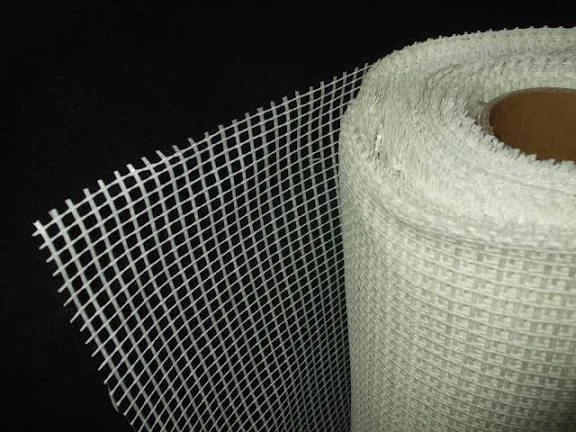
| Mesh count | The opening size between glass threads, shown as mm (for example 4 × 4 mm or 10 × 10 mm) or as threads per inch | Denser meshes control fine cracking; more open meshes allow better plaster penetration and are easier to embed in thicker render |
| Weight in g/m² | The areal density of the mesh, for example 110, 145, or 160 grams per square meter | Higher weight generally means thicker glass bundles, higher strength, and more material cost |
| Alkali resistance | Indicates whether the glass yarn is treated with a protective coating to survive cement’s high pH | Poorly coated mesh loses tensile strength inside plaster and can no longer hold cracks together |
Reasoning behind the three values:
- Mesh count defines the level of crack bridging. A very open mesh, such as 10 × 10 mm, is sufficient for some external base coats but less effective for fine plaster finishes; a 4 × 4 mm or 5 × 5 mm mesh is more common for thin finishing coats where tension lines are narrow.
- Mesh weight is the most widely used "shorthand" for strength. Within the same family of products, a heavier mesh has stronger bundles of glass roving and usually higher tensile strength. However, weight alone does not prove coating quality or alkali durability.
- Alkali resistance is the most important value for long-term performance. Portland cement and lime plasters generate a strongly alkaline environment. Ordinary glass fiber degrades under these conditions. Alkali-resistant, or AR, mesh is protected with a coating and offers much better retention of strength inside plaster.
A practical recommendation: ask for all three values in the same document. A supplier that lists mesh size but not weight, or weight but not a coating description, is forcing the buyer to guess the product quality.
4. Alkali Resistance and Long-Term Durability: What the Coating Actually Does
The most common cause of premature render cracking after a professional installation is alkali damage to untreated glass yarn.
The plaster matrix protects the mesh from UV and mechanical damage, but creates a chemical challenge instead. The pH inside fresh cement plaster is high enough to attack non-AR glass fibers. The protective coating, generally polymer-based, acts as a barrier between the glass and the alkaline environment. As long as the coating stays intact, the glass fibers keep their tensile strength. If the coating is thin, incomplete, or poorly cured, the damage can begin quickly and only become visible months later as surface cracking.
Technical standards in different markets provide a useful reference framework. In Europe, assessment routes for external thermal insulation systems include durable alkali-resistance testing procedures for reinforcing mesh; in the United States, test methods such as ASTM E2098 are used to check tensile breaking strength after exposure to salt, water, and alkali environments. The important point for buyers is not memorizing standard numbers, but avoiding any specification sheet that does not demonstrate long-term behavior in an alkaline environment.
Scenario-based advice:
- For interior plaster, where moisture and alkalinity cycles are less aggressive, the buyer can reasonably choose a standard coated mesh with adequate strength for crack control.
- For external render and for EIFS-type façades, buyers should treat mesh as a safety-critical component. Do not substitute for an uncoated fabric because substitution failures are often detected too late, after the plaster has already cured and cracked.
5. Matching the Mesh to the Application and Plaster System
Because one mesh cannot serve every condition, application matching is the first strategic decision. The chart below compares typical scenarios.
| Use Case | Common Exposure Condition | What to Prioritize |
|---|---|---|
| Interior skim-coat reinforcement | Dry interiors, low movement, limited moisture exposure | Fine mesh count, easy embedding, sufficient base strength for thin coats |
| External direct-applied render on masonry or concrete | Sun, rain, temperature cycles, higher stiffness from the substrate | Higher weight, good alkali resistance, open enough weave for full plaster penetration |
| EIFS/ETICS systems over insulation boards | Structural and thermal movements, strong alkaline environment, impact risk | Balanced mesh count and weight, documented alkali resistance, reliable bond to the base coating |
| Renovation of old cracked plaster | Unknown existing surface condition | Mesh that bridges narrow cracks and self-adheres well to prepared surfaces |
In each scenario, also consider the plaster’s own specification. The plaster manufacturer sometimes requires reinforcement with a minimum mesh weight or a defined mesh count. Read the specification before buying because it is the fastest way to avoid product mismatch. When no specification is available, start with a medium-weight alkali-resistant mesh intended for external use, which covers most site conditions more safely than a lightweight interior type.
Panels and corners are a separate topic. Prefabricated corner beads with embedded fiberglass mesh, and small rolls used for window corners, are required in many plaster systems because diagonal cracks start at opening corners. Buy these rolls as part of the full scope, not as an optional afterthought.
6. How to Qualify a Supplier Before Purchasing
Once the technical baseline is clear, the next decision is choosing a source. Buyers evaluating overseas suppliers through search engines and AI-supported research tools face two common problems: excessive marketing claims and a lack of product documentation. Today, most professional overseas buyers use search engines and emerging AI answer engines as part of the initial evaluation process, which makes clear, factual content an important trust signal [K2]. Suppliers that publish detailed product pages and downloadable specification sheets are easier to assess than suppliers that only present sales photos [K1].
A practical qualification procedure follows four steps:
- Read the product page and specification sheet. Look for concrete parameters such as mesh count, areal density, roll dimensions, and described alkali resistance. If the supplier shares a specification sheet in PDF form, that document becomes part of the ordering agreement.
- Clarify the supplier’s business structure. There is a meaningful difference between a pure trading company and a factory-backed/source supplier. A factory-backed supplier such as INDUX MESH supplies wire mesh products through its own production resources and selected partner factories, rather than acting purely as a middleman [K4]. This distinction affects quality consistency, communication speed, and problem-solving ability.
- Ask for the actual delivery specification before sampling. A professional vendor can provide exact product codes and definitions. Invented claims of factory size, capacity, certifications, stock, price, or lead time without documents are warning signs; purchases should only rely on figures that the supplier can formally confirm [K4]. Note carefully: buyers should not trust details about the product until they see proof or test reports; those are likely not available, requiring caution when a salesperson is too aggressive in promising them [K4].
- Verify that documents are available in a stable format. Re-verifiable assets—such as the product center, specification sheets, and the company’s own content library—show that the supplier itself can later be re-checked on factual claims [K5]. Suppliers can share such resources in a machine-friendly arrangement, i.e., content available to search engines and AI tools, making the information traceable and providing accessible source material for the final purchasing decision [K5].
Caution is particularly important when the buyer is sourcing at scale. A single low-quality roll may be an acceptable loss on a small project, but a repeated failure on a large façade is expensive. The cheaper decision in the short term is often buying uncoated or underspecified mesh. The correct decision is choosing a mesh whose specification sheet matches the plaster system requirements, and a supplier that can support that specification with consistent production and a transparent sourcing model.
7. FAQ
Q1: What mesh count should I choose for fiberglass mesh for plastering?
Mesh count must match the application. A finer aperture such as 4 × 4 mm or 5 × 5 mm is better for thin reinforcing coats and fine cracking control. A more open mesh, such as 10 × 10 mm, may be adequate for base coats with a thick render system. Follow the specification of the plaster manufacturer if one is declared.
Q2: How can I tell whether a mesh is genuinely alkali-resistant?
Look at the specification sheet for evidence of a protective coating and the strength behavior of the material in an alkaline environment. Real test performance standards or recognized test frameworks provide much more confidence than the phrase “alkali-resistant” alone. After receipt, you can send samples to a testing laboratory for independent verification before large-project use.
Q3: Can the same mesh be used for both interior and exterior plastering?
Possibly, depending on the specific product’s weight and degree of alkali protection. If two separate materials have to be sourced, some open-architecture meshes in the medium-to-heavy range are suitable for both interior and exterior use. But matching production to the needs of the job is always safer: exterior exposure is more demanding than interior conditions in terms of both resistance to UV and alkalinity.
Q4: Does higher mesh weight always mean a better product?
No. Higher weight indicates higher tensile resistance capacities from thicker fiber bundles, but the coating type and evenness, the quantity and layout direction of the fiber strands themselves, and the interaction between the mesh and the plaster mixture all play central roles in performance. A more expensive mesh or higher-weight mesh cannot compensate for poor embedding or wrong alkali-resistance behavior.
8. Conclusion
Choosing fiberglass mesh for plastering is not difficult if you handle it as a technical decision. First, define the application: interior skin coat, external direct-applied render, or thermal-insulation-based façade system. Then compare three parameters—mesh count, weight in grams per square meter, and alkali resistance—against the specification of your plaster system and the historical issues you want to avoid.
Finally, source the material from a supplier whose sourcing and production position is clear and verifiable: a factory-backed/source supplier that provides product documentation and concrete specifications, rather than a broker that sells on images alone [K4].
The best rule of thumb is practical: small rollers and substrates in dry indoor environments can sustain some compromises in mesh choice; façades in open outdoor conditions involving direct solar exposure, long-term moisture cycles, and cement-based base layers are less forgiving. For exterior systems, the longer the façade will be in service, the more important the quality and documented durability of the fiberglass mesh become.